
Introduction
In today’s cybersecurity landscape, visualizing and rapidly understanding firewall activity is crucial to maintaining a secure network environment. Firewall GeoIP Threat Monitoring leverages advanced visualization tools to present real-time firewall data, transforming complex security logs into clear, actionable insights. This approach allows administrators to instantly detect potential threats and understand the geographic distribution of attempted network access, enhancing response capabilities and situational awareness.
This solution is particularly useful for organizations that need detailed visibility into their network security posture. It is ideal for detecting and responding to suspicious activities, tracking patterns in attack sources, and managing firewall rules proactively. Whether used by cybersecurity professionals, network administrators, or IT managers, this geo-visualization approach significantly simplifies monitoring and incident response.

Services Used for this Project:
- OPNsense: A powerful, open-source firewall and routing platform providing robust security capabilities, VPN support, and advanced monitoring tools.
- Grafana: An open-source visualization and analytics platform used for creating interactive dashboards and maps to represent complex data clearly.
- Graylog: A centralized log management tool that collects, processes, and enriches log data from various sources, providing insightful analytics through pipeline processing.
- OpenSearch: An open-source search and analytics suite, capable of storing, indexing, and querying large datasets efficiently, serving as the backend for log storage.
- InfluxDB: A high-performance time-series database designed to handle large volumes of timestamped data, ideal for monitoring metrics like bandwidth and system performance.
Process
Setting up Firewall GeoIP Threat Monitoring begins with configuring OPNsense to forward firewall logs to a centralized logging solution. The firewall must be configured to send syslog data to Graylog, ensuring logs capture crucial firewall actions such as blocked or allowed traffic.
In Graylog, incoming firewall logs are ingested and parsed using custom extractors to separate meaningful fields like source IP, destination IP, action (block/pass), and protocols. These fields are crucial for subsequent analysis and visualization. Proper parsing ensures logs are structured and actionable.
Next, Graylog leverages pipeline rules to enrich these parsed logs with geographic data. This step involves configuring a GeoIP lookup table using MaxMind’s GeoIP database, enabling automatic tagging of logs with accurate geographical coordinates, such as latitude and longitude, based on the source or destination IP addresses.
Once the logs are enriched, they are stored and indexed by OpenSearch. OpenSearch efficiently manages these logs, providing rapid search capabilities for real-time querying. It acts as the robust storage backend, enabling quick access and analysis of log data required for visualization in Grafana.
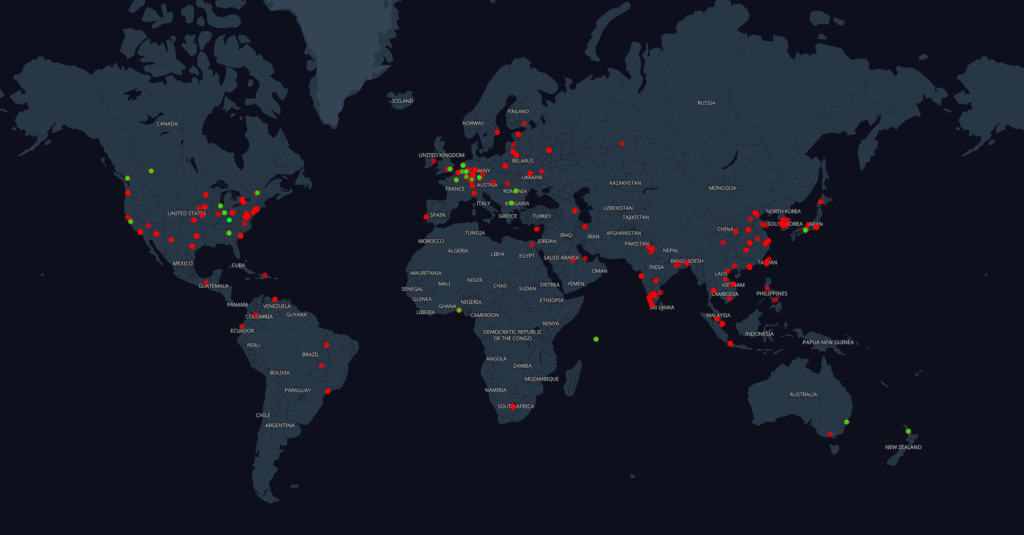
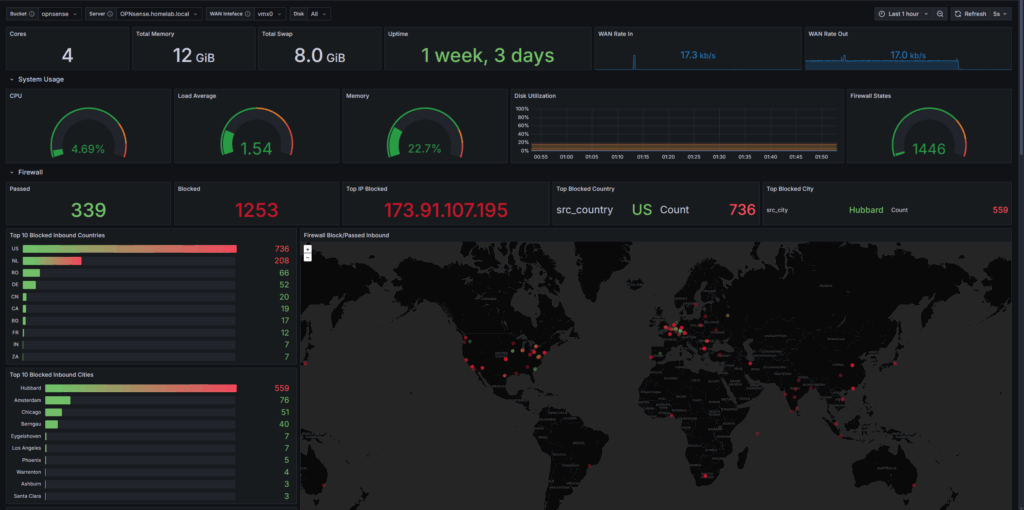
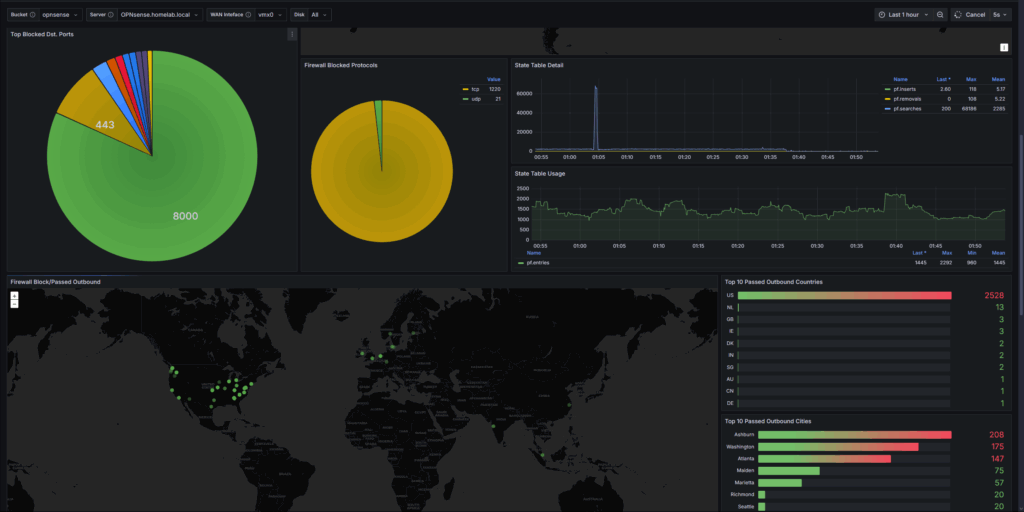
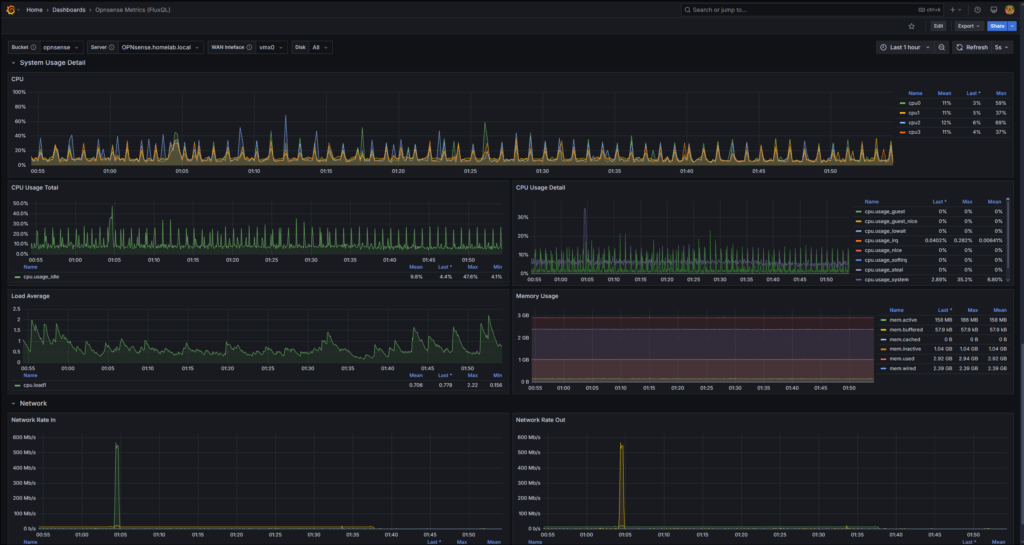
Grafana connects to OpenSearch to pull in this enriched data, presenting it visually on an interactive world map. Data points are color-coded—red points indicate blocked traffic, while green points represent allowed connections. Grafana also integrates with InfluxDB to incorporate additional firewall metrics, such as bandwidth usage and performance statistics, enhancing the overall comprehensiveness of the monitoring solution.
The resulting Grafana dashboard delivers immediate visual insight into firewall activities, helping network administrators quickly identify and respond to emerging threats, understand global access patterns, and maintain optimal network security.
Conclusion
Firewall GeoIP Threat Monitoring using Grafana, Graylog, and OpenSearch provides a powerful, intuitive visualization solution that significantly enhances network security management. By translating firewall logs into visual data points on a global map, it facilitates rapid threat identification, proactive security adjustments, and comprehensive monitoring. This integrated approach is invaluable for any organization aiming to bolster its cybersecurity defenses through effective, real-time visualization.