Welcome to my deep dive into home automation, where I showcase how I’ve integrated Home Assistant with my professional URC (Universal Remote Control) system. In this post, I’ll walk through the setup, real-world use cases, and how this integration brings seamless control to my smart home environment.
Whats the point?
Home automation simplifies everyday tasks by allowing you to control lights, climate, security, and entertainment systems from one central platform or even automatically. It adds convenience, increases energy efficiency, and enhances home security—making it an increasingly popular choice for modern living. As smart devices become more affordable and accessible, more people are embracing automation to create personalized, responsive home environments.
Universal Remote Control (URC)

Universal Remote Control (URC) is a leader in premium home and commercial automation, offering the Total Control platform to unify lighting, audio, video, climate, and security systems through a single interface. At the heart of this ecosystem is Accelerator 3, URC’s powerful programming software that enables certified integrators to create deeply customized automation experiences. With features like geofencing, conditional logic, and support for third-party devices, Accelerator 3 provides the flexibility to build robust, scalable smart environments.1
Home Assistant (HAOS)
Home Assistant is an open-source platform for automating and controlling smart home devices from a single interface. It supports thousands of integrations, allowing complete customization and local control without relying on the cloud.
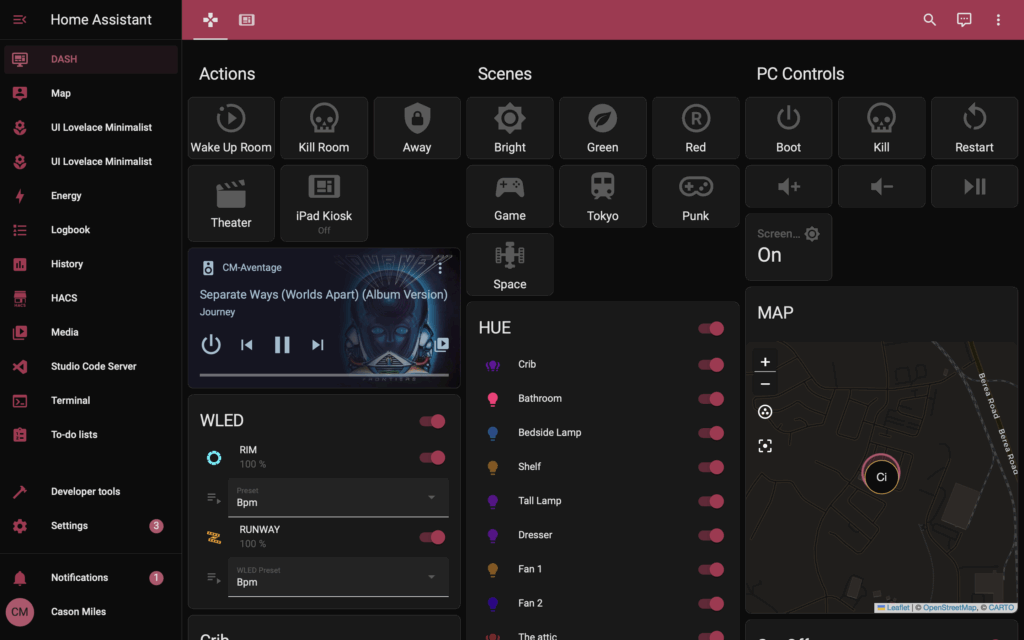
This screenshot showcases my custom Home Assistant dashboard, which centralizes control for a wide range of smart home devices and automations. It integrates Philips Hue smart lighting, WLED strips, a Yamaha home theater receiver, TV and media playback, as well as environmental controls like a smart thermostat. With a single interface, I can trigger scenes, manage devices, view presence-based maps, and control my entire setup with ease and precision.
Why not mix the two?
In my personal setup, I’ve implemented both URC and Home Assistant to create a powerful, hybrid smart home system. URC serves as the backbone for controlling most consumer electronics like my Samsung TV, Philips Hue lights, and Fire TV, offering reliable performance and the convenience of handheld remotes. These remotes integrate seamlessly into the system, allowing traditional control alongside automation, making it ideal for everyday use and guests who prefer a familiar interface.
However, where URC falls short is in flexibility and support for non-traditional or open-source devices. That’s where Home Assistant fills the gap—it allows me to integrate and control devices like WLED lighting and even my PC using the HASS Agent app, something URC can’t natively handle. By combining the strengths of both platforms, I’ve built a smart home that is not only highly functional but also deeply customizable.